Tuesday, April 19, 2022

Playing President: My Close Encounters with Nixon, Carter, Bush I, Reagan, and Clinton—and How They Did Not Prepare Me for George W. Bush by Robert Scheer


BOOK REVIEW - FIVE STARS

Playing President: My Close Encounters with Nixon, Carter, Bush I, Reagan, and Clinton—and How They Did Not Prepare Me for George W. Bush by Robert Scheer

Well-written, greatly insightful, and very timely. This compendium of historical political leaders that shaped world history is a must read for all.

I loved it!

Excerpts:

Truman, guided by that brilliant lawyer Dean Acheson, was quite aware that by 1940 the world Depression of the early ’30s had returned. The New Deal of Franklin Roosevelt had largely failed. What was to be done? FDR took a crash course in Keynesian economics. As a result, he invested $8 billion into re-arming the United States, in order to hold our own against the Fascist axis of Germany, Japan, Italy. To the astonishment of Roosevelt’s conservative political enemies, the U.S. suddenly had full employment for the work force and a military machine of the first rank with which we were able to defeat Fascism, and just about anyone else who defied us. Truman and friends learned and never forgot an important lesson:

Freedom of the press is guaranteed only to those who own one,” and in the time of Jefferson, that group included much of the electorate.


Nixon “did a number of undeniably good things that have been forgotten. He negotiated the first and only strategic arms limitation treaty, the opening to China. He ended the war, ended the draft; the eighteen-year-old vote came under his presidency. He did a lot of good things and they all got swept away by Watergate.”

Nixon’s foreign policy achievements are the focus of the current reappraisal, though some commentators also praise aspects of his domestic policy, especially his establishment of the Environmental Protection Agency and his efforts to reform the welfare system.


Ironically, when I had asked Carter during our 1976 Playboy interview what would prevent his leading the U.S. into a Vietnam-type quagmire, he stated that he wouldn’t “lie,” as Lyndon Johnson had. At the time, I thought this was the most truly controversial statement in the interview—not the “lust” quote that was so widely publicized. Johnson’s widow, Lady Bird, felt the same way, and she initially refused to meet with Carter when he landed in Dallas soon after the interview was published. Sadly, Carter went on to commit the same lie of inventing a national security threat—with dire consequences.


John's author's page on Amazon

Valiant Ambition (The American Revolution Series) by Nathaniel Philbrick


BOOK REVIEW - FIVE STARS

Valiant Ambition (The American Revolution Series) by Nathaniel Philbrick

An eye opening look at the rocky road United States stumbled through on its way to independence. I found this story extraordinary and enlightening, and far more revealing than all of my previous studies had taught me.

The provocative history was not a slam dunk described in history books. This is truly recommended reading.

Excerpts:

Like many American mariners and merchants, Arnold’s early revolutionary beliefs had been nurtured in the smuggling trade. For men like John Hancock in Boston and Arnold in New Haven, finding a way around the stifling economic restrictions imposed by the British government had been not only a financial necessity but an expression of patriotism, a finger in the eye of the British regime. Now that the Continental Congress in Philadelphia had proven to be, if anything, even more dysfunctional and unjust than the ministry in London, Arnold saw nothing disloyal in doing what Americans had always done: profit as best they could from whatever


The city was a shambles. The British had used the State House as a prison, and the floors of its once immaculate rooms were heaped with human waste. The newly returned delegates of the Continental Congress had to meet temporarily in nearby College Hall until the filth could be removed. Other public buildings and “genteel houses” had been used for stables by the British, who cut holes in the floors so that the dung could be shoveled into the cellars. According to the New Hampshire delegate Josiah Bartlett, “The country northward of the city for several miles is one common waste, the houses burnt, the fruit trees and others cut down and carried off, fences carried away, gardens, and orchards destroyed.” Over the course of the next few weeks, thousands of citizens who had spent the winter outside Philadelphia flooded back into the ravaged city. Not unexpectedly, they had little sympathy for anyone who had fraternized with the enemy.


The United States had been created through an act of disloyalty. No matter how eloquently the Declaration of Independence had attempted to justify the American rebellion, a residual guilt hovered over the circumstances of the country’s founding.

By threatening to destroy the newly created republic through, ironically, his own betrayal, Arnold gave this nation of traitors the greatest of gifts: a myth of creation. The American people had come to revere George Washington, but a hero alone was not sufficient to bring them together. Now they had the despised villain Benedict Arnold.

As Arnold had demonstrated, the real enemy was not Great Britain, but those Americans who sought to undercut their fellow citizens’ commitment to one another. Whether it was Joseph Reed’s willingness to promote his state’s interests at the expense of what was best for the country as a whole or Arnold’s decision to sell his loyalty to the highest bidder, the greatest danger to America’s future came from self-serving opportunism masquerading as patriotism.


John's author's page on Amazon

Friday, April 15, 2022

Captain George Tappin: A True Story.


Captain George Tappin: A True Story is the fourth short story in the series the Doings of Dudley Doolittle.

Though our old and trusted friend George Tappin is long gone he lives on fondly in our memories.

Therefore we will use his real name here and make this story a  tribute to Captain George.

Our first experiences with commercial fishing in Florida: I took George Tappin up on his offer of a day out on his shrimp trawler, Terry. It turned out that George’s wife Mary was scared to death to go out to sea with George because of an incident that occurred when they were coming in the inlet in very heavy seas. George had been going out by himself, which to me seems impossible, but he did do it just the same. The first trip I made with George was a wonderful experience, and I asked if he would mind taking Jane the next time and he agreed. The one thing that happened the first day I was out with George was that one after another his bilge pumps all failed. He rigged another and another until his seventh one didn’t work. He was a real resourceful sailor and instinctively went down to his main engine that was a 6-71 Detroit Diesel and rerouted the engine raw water pickup hose to suck the bilge water and discharge it overboard. That was enough to keep us afloat until we could get back to the dock. I have to state here one of the basic rules of boating; “the water is supposed to be on the outside.”

Jane’s reaction on her first trip out on the Terry with George was that she wished that she hadn’t wasted so many years working at the finance company back in Superior, Wisconsin. She could have been out here upon the ocean instead. There was always plenty of action on the shrimp boat.

One of my jobs on George’s boat was to open the net when it was hauled onboard and hoisted high up in the rigging. To visualize this you must consider that the boat is always in constant motion while it passes through the seas. When the full net is overhead, I would go under it and grab hold of the trip line that would open the bag portion of the net to release the catch. Timing and coordination are crucial because if the net isn’t opened at the precise time, the catch can be released back overboard while the roll of the boat keeps the net perpetually swinging overhead.

The varieties of living things that come out of the net are astounding. Crabs with their pinches poised to shake hands with you, catfish with their dorsal fins ready to stab, sting rays with their tails armed with a jagged venomous spear, electric skates will jolt you, sea turtles just want to snap, but sharks want a piece of flesh. One day when I opened the net, out came a 7-½ foot shark that was flipping around the deck like a bucking bronco but at the same time was vigorously snapping its razor sharp teeth at everything in sight. I instantly got the message and sprung up in the rigging and told George that he had a visitor to take care of. George didn’t bat an eye and came from the wheelhouse with a carpenter’s knife and took a flying tackle on the shark. Next, he slit the shark’s bottom side from one end to the other and spilled the shark’s guts onto the deck. Now the shark got even more aggressive and snatched our fishing net in its razor toothed mouth and began to aggressively thrash. Again I called George and told him of the new problem. This time he came with a hammer and commenced to bash in the shark’s head. Now the shark became docile for a moment and George then fastened a rope to the shark’s tail and hoisted it up into the air using the winch. With the roll of the boat, the shark swung overboard, and George then let the shark down so that he could cut the rope on its tail. The shark was back to thrashing again and when the rope was cut and it hit the water, the other sharks in the vicinity completely tore this shark to shreds in a seconds. After witnessing this chain of events I was convinced that you never wanted to fall overboard from a shrimp boat. For the remainder of this winter season, Jane and I went out fishing with George Tappin two or three times a week. This was some of the best fun we had our entire time in St. Augustine this winter season. We thought of ourselves extremely fortunate to be able to have this life changing opportunity. We even got paid plus as a fringe benefit we had all of the seafood we could eat.

More colorful stories of Captain George Tappin can be found in our books of our life aboard our sailboat Dursmirg. Check the following links.

Sailing Beyond Lake Superior : Travels of Dursmirg

Sailing to St. Augustine: Travels of Dursmirg

Remembering 1954: Marjories Kennen Rawlings and George Tappin

Dying of cancer the last words George spoke to me from his death bed were “John, I would give anything if I could just walk out that door.”

John's author's page on Amazon


Tuesday, April 12, 2022

The Baker Chocolate Company: A Sweet History by Anthony M. Sammarco


BOOK REVIEW - FIVE STARS

The Baker Chocolate Company: A Sweet History by Anthony M. Sammarco

Growing up with America, this popular brand was a standard product in homes across the nation. I loved the book’s historical impact with its beginning in precolonial Mexico thousands of years ago and then the popularity that has gone world wide.

The book takes the reader in to the age of corporate take overs and thus is timely.


EXCERPTS:

The exact significance and attributes of Quetzalcoatl varied somewhat between each of these civilizations and throughout history. Quetzalcoatl was often considered the god of the morning star, while his twin brother, Xolotl, was considered the evening star. As the morning star, Quetzalcoatl was known under the title Tlahuizcalpantecuhtli, which means literally “the lord of the star of the dawn.” He was known and worshiped as the inventor of books and the lunar calendar, the giver of maize corn to mankind and sometimes as a symbol of death and resurrection. Quetzalcoatl was also the patron of the priests and held the revered title of the Aztec high priest.


Baron Justus von Liebig (1803–1873), noted German chemist who made significant contributions to the analysis of organic compounds and the application of chemistry to biology and agriculture, was quoted in the 1893 edition of Baker Chocolate’s Choice Recipes, stating that chocolate is a perfect food, as wholesome as delicious, a beneficent restorer of exhausted power; but its quality must be good, and it must be carefully prepared. It is highly nourishing and easily digested, and is fitted to repair wasted strength, preserve health, and prolong life. It agrees with dry temperaments and convalescents; with mothers who nurse their children; with those whose occupations oblige them to undergo severe mental strains; with public speakers, and with all those who give to work a portion of the time needed for sleep. It soothes both stomach and brain, and for this reason, as well as for others, it is the best friend of those engaged in literary pursuits.

John's author's page on Amazon

Monday, April 11, 2022

A History Lover's Guide to New York City (History & Guide) by Alison Fortier

BOOK REVIEW - FIVE STARS

A History Lover's Guide to New York City (History & Guide) by Alison Fortier

Fun to read, educational and extremely interesting. I loved the well-edited and organized presentation that left me with many happy recollections.

EXCERPTS:

A popular referendum on creating a Greater New York passed in 1894. It took a few more years to realize what this would mean in practical terms. On January 1, 1898, Manhattan, Brooklyn, Queens, the Bronx and Staten Island became the five boroughs, or administrative units, of one New York City. By a "stroke of a pen," New York's population increased to three million, making it the second-largest city in the world after London.


The last sixty-five years have been mostly good ones for New York City. The exception was a period during the 1970s when the city’s finances failed. Government overspending and the departure of industry and jobs to cheaper areas hurt New York as a place to live and work.

High unemployment and escalating crime, rampant drug use and inadequate public services left garbage piling up on street corners and graffiti on buildings and subway cars. New York City was a difficult place to live. Population numbers declined—not until the 2000 census did the population exceed what it had been in 1950. A citywide power blackout in 1977 symbolized the city’s fate. The future looked dark. At its depths, New York City appealed to the federal government for financial aid to avoid bankruptcy. The administration of President Gerald Ford denied the aid. The New York Daily News paraphrased the president’s position in its famous October 30, 1975 headline: “Ford to City: Drop Dead.” Despite the fact that the Ford administration reversed itself within a few months and offered federal loan guarantees to New York City, Ford narrowly lost the state of New York to Democratic nominee Jimmy Carter in the 1976 presidential election. Jimmy Carter went on to the White House to become our thirty-ninth president. Gerald Ford blamed this headline for costing him the election.


John's author's page on Amazon

Sunday, March 20, 2022

Fire Over the Rock: The Great Siege of Gibraltar, 1779–1783 by James Falkner


 Five Stars

Fire Over the Rock: The Great Siege of Gibraltar, 1779–1783 by James Falkner

The British Empire...The sun never sets on the British empire. This monumental story of the happenings that were traded off for political power in an insatiable land grabbing quest to seize every crumb of international commerce had no foreseeable limits.

I loved the book for its insightful visage of the powers at play and the evolutionary consequences that made these happenings world history.

By the way, the sun finally set on the British Empire.

EXCERPTS:

Great Britain was striving to suppress rebellion in North America. By the summer of 1779, British forces had been engaged for four years in what seemed to be the fruitless task of trying to remain in possession of the American colonies. Considerable attention also had to be devoted to securing important territories in the West Indies, and maintaining influence across the Indian Ocean. Without much doubt, had Great Britain not been so deeply engaged in the task of trying to fight a war in North America, Spain would not have tried to regain Gibraltar in such a fashion. This was particularly so as London had indicated, on several occasions, that the Rock was not really worth holding, and some subtle diplomacy by Madrid

The rapidly growing British Empire, still in comparative infancy in the 1770s, depended upon trade on the high seas, and security and ease of navigation through the Mediterranean was a key factor in this strategic endeavor. British trade interests in the spice and sugar islands of the Caribbean, across the Indian sub-continent, and in the Mediterranean, were of greater potential value and importance to Great Britain than holding on to rebellious and very unprofitable colonies in North America. No imperial power relished the loss of territory, Gibraltar is situated in Andalusia, the most southern province of Spain … a little world of itself,’ wrote John Drinkwater, a veteran of the years of the Great Siege.

Review by John M. Grimsrud

View John's author's page on Amazon.


The Real Dirt on America's Frontier Legends by Jim Motavalli


Five Stars

The Real Dirt on America's Frontier Legends by Jim Motavalli

In this book frontier heroes and legendary true life personalities I read about in my childhood are scrutinized and investigated. As the book progressed the stories picked up speed and became even more interesting. I loved the behind the scenes look at the outlandish personalities that became legends in their own lifetimes.

A great read!

Excerpts: The settled US was quite small in 1801, when Thomas Jefferson became president. Two of every three Americans lived within fifty miles of the Atlantic, and the Mississippi was the western border. Jefferson himself had never been more than fifty miles west of the Shenandoah Valley, so it’s not surprising he would want to see the West mapped and explored. The hope was for an easy and navigable route to Asian trade routes.

During the Civil War there was three-times-wounded “Jack Williams” (actually Frances Clalin), “Franklin Flint Thompson” (Sarah Edmonds), “Samuel ‘Sammy’ Blalock” (Sarah Pritchard), and even Irish-born “Albert Cashier” (Jennie Hodgers), who continued living as a man after the war. But Williams was the first documented black woman to enlist in the army, and maybe the last until the military was desegregated in 1948.


Martha Canary
(“Calamity Jane”) The Legend Calamity Jane was a muleskinner, stagecoach driver, Pony Express rider “over one of the roughest trails in the Black Hills country,” and an intimate of both Wild Bill Hickok and General George Armstrong Custer. She was a lover of the former, and the latter benefited from her scouting prowess in Arizona circa 1870.

By her own account in the 1897 pamphlet Life and Adventures of Calamity Jane, the Custer trip was eventful. “During that time I had a great many adventures with the Indians, for as a scout I had a great many dangerous missions to perform, and while I was in many close places always succeeded in getting away safely.” Why? Because she “was considered the most reckless and daring rider and one of the best shots in the western country.” Some Indian observers thought she had supernatural powers.

On recovering, Egan exclaimed, “You are a good person to have around in a time of calamity. And I now christen you Calamity Jane, heroine of the plains.”


The earliest Calamity Jane picture, the silent 1915 In the Days of ’75 and ’76, is the first to depict a romance (and a marriage) between Wild Bill Hickok and Calamity Jane, but hardly the last. And because she sometimes dressed in men’s clothing, Calamity is also something of a lesbian icon.

Doris Day singing “Secret Love” in the film Calamity Jane is cited for its venting of forbidden feelings in the documentary The Celluloid Closet.

Calamity Jane (likely born Martha Canary) claims in her short autobiography is true, nor are many of the legends that grew up around her. The real Calamity Jane was trouble, a drunk, an illiterate, and a teller of tall tales who caused mayhem wherever she went—and that’s the real origin of her name.

Jane had an uncanny ability (James Beckwourth shared it) to be where western history was being made.

Creators evidently wanted to split the difference between fact and fiction, because Calamity—while not linked romantically with Hickok—is still shown as better acquainted with him than she actually was.

See John M Grimsrud's author's page Amazon

Monday, March 14, 2022

Keg of Beer St. Augustine-Dudley Doolittle


Keg of Beer in St. Augustine, Florida: The third short story in the series Doings of Dudley Doolittle.

A fictitious name will be used in most of the stories. It is there to protect the identity of the guilty.

These true stories are over half a century old or more.

We met this outlandish, outrageous one of a kind individual upon arriving in St. Augustine, Florida, December 1972, when we anchored our home built and designed sailboat Dursmirg our first night in town. We invited Dudley and his partner to visit our boat and have a beer. They arrived by dinghy and our friendship began over a sociable tap beer. We kept a 16 gallon keg of beer in our bilge with a tap in the galley next to the water tap that was installed before we launched the boat. It had a CO2 cylinder with regulator to keep it fresh and pressurized. All across the Great Lakes the lake water kept it cool. In Florida we had escaped the frigid latitudes that kept our bilge temperature refrigerator fresh.

The first thing that Dudley said was; “the beer is warm.” Before the evening was over there were 12 dinghies tethered behind our boat to partake in our hospitality. As I have said before people that are free with their drinks have lots of fair weather friends.

I noticed that Dudley who had remarked about the “warm beer” didn’t leave until the last drop of beer came out of the tap.

A brief look at what brought Dudley to the anchored out life: He was born in North Florida in what was then jokingly called St. Augustine, Georgia. Dudley was conscripted into the military during WW ll. After surviving the war Dudley returned to North Florida, got married, had three children, and a happy home life. Tragedy struck. His young wife, age 38, died of cancer and Dudley couldn’t cope. He dropped out, hit the road and wound up in California when the pot smoking free loving anti-Vietnam protesters were experimenting with high times mind altering substances.

Long story short:

Dudley returned to St. Augustine and purchased a 42 foot Nova Scotia sailing schooner for $300 dollars. His bargain boat had a significant problem, it was on the bottom. The number one rule of boating is the water is supposed to be on the outside.

Omitting the details, he resurrected the vessel, cleaned it up, and moved aboard. His partner Linda got a shop manual for the engine and miraculously got it running...a challenge for a seasoned mechanic.

Their new anchored out home turned out to be a bargain with some determined toil that opened up a totally new world of adventuresome if not slapstick semi-calamitous adventures.

Dudley's brother had this to say; “Dudley tries to piss in four corners at the same time, hell, he ought to know that I am the only one that can do that.”

In summation:
Dudley was a real character, and a chip off the old block!
When his mother was ninety years old she went off all her medications, called the family together for a mock funeral that was a party and an all you can eat extravaganza.  She announced to all:  This party is my funeral, when I die you don't have to show up!
Dudley used to say "being crazy kept me from going insane."

It is too much of a story to tell it all here now but this audacious tale with highlights and photos can be enjoyed in the book, Sailing to St. Augustine, available in paper or digital.

My preference is the digital book which is not only cheaper but delivered into your hands instantaneously anywhere in the world to your computer or reading device, and is much easier to read with its adjustable font size plus brightness, contrast, built in dictionary and more. So enjoy this new traveling companion.

Happy trails to you. John M. Grimsrud

John's author's page on Amazon

Sunday, March 6, 2022

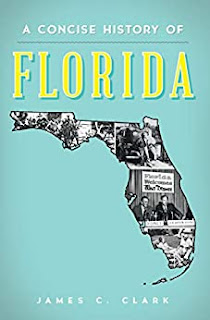
A Concise History of Florida by James C. Clark - Book Review

Book Review-Five Stars

A Concise History of Florida by James C. Clark

A joy to read!  This well written, excellently edited, and true life American history story covers an amazing phase in the development of a totally unique geographic area.

Peaceful places have no history, something that Florida abounds in.

I loved its depictions that intrigue and clearly bring to life enlightening events in a fascinating informative way.

EXCERPTS:

One sign that the Spanish had come before is seen in the hostile reaction Ponce de León and other explorers received. The Indians had apparently encountered the outsiders before, and the experience was negative.

2,000 BC: First fired-clay pottery comes into use. 500 BC: Mound building takes place along the Crystal River. AD 700: Indian tribes, including the Timucuan, Apalachee, Calusa and Tequesta, are formed.

“Dixie” was heard everywhere. Union troops occupied Pensacola during the war and a regiment of the colorfully dressed New York Zouave soldiers offered a night of entertainment for the community. The show featured soldiers singing songs strong country music roots as evidenced by two of country music’s early stars, Mel Tillis and Slim Whitman. Tillis was born in Dover in 1932, and after a stint in the military, he began writing and then singing songs. In 2012, President Barack Obama awarded Tillis the National Medal of Arts. Whitman was born in Tampa, and his yodeling and high falsetto became an early staple of country music beginning in the 1950s. His hits “Indian Love Call” and “Rose Marie” became country and western classics. Whitman toured with Elvis Presley early in Presley’s career. Presley sang in Florida with two country music tours, one headlined by Hank Snow and the other by Andy Griffith. After he became a star, Presley returned to film Follow That Dream in Ocala and Yankeetown. Singer John Anderson from Apopka had a string of country hits.

RAY CHARLES; Ray Charles had a life filled with great success and great tragedy. He was born in Georgia, but his family moved to Greenville, a small town in the Florida Panhandle. His mother was a sharecropper, and his father worked as a railroad repairman. He played around the shacks where blacks lived in Greenville.

His mother sent him to the Florida School for the Deaf and Blind in St. Augustine. While he was there, his parents died. He learned to play the piano and performed on a local radio station. He came to hate the school and was expelled when he was fifteen years old.

South Florida has given the music a decidedly Latin flavor best exemplified by Cuban-born Gloria Estefan. Her father was a soldier and bodyguard for Cuban dictator Fulgencio Batista. Her family fled to Miami as a result of the revolution that overthrew Batista. She married Emilio Estefan, the leader of the Miami Sound Machine, in 1978. Gloria Estefan became increasingly popular, and eventually the band’s name was changed to Gloria Estefan and the Miami Sound Machine. Down in the Florida Keys, Jimmy Buffett created his own sound that made him a legend.


Friday, February 11, 2022

Looking Back Fifty Years - Launch of Dursmirg


Looking Back Fifty Years

It is fifty years since we launched our self-designed and home-built 46-foot sailboat Dursmirg. Building and sailing Dursmirg was a life changing experience. Our reward was fifteen of the very best years of our lives. Now we can look back at where the world has come to in the past half century.

Our adventuresome life aboard Dursmirg became even better with every unrelenting passing escapade.

This was in the era before the internet. There was no email, only snail mail. Self-sufficiency was the key. I made a rain catcher and never went to the dock for drinking water. We had solar hot water, a wind powered generator, refrigeration achieved by converting an absorption refrigerator to run on lamp oil.

Fresh seafood prepared exquisitely by my culinary dream girl with her secret ingredient: creativity.

We became extraordinary sailors because of the Arab oil embargo. Silently going where the wind blew us, when the spirit moved us, and the price was right.

We lived out of the sea and off the land. With no motor vehicles we used bicycles, and we sailing and rowing dinghy. Sailing up the anchors and getting under way was quick, easy and enjoyable no engine used. We also had the ability to fabricate necessities. The sewing machine had a hand crank. We went snorkel diving for salvage, plus lobster and conch hunting. We combed the beaches for fun and collected usable items like bottles for our home-made beer and wine production, lumber for crafts and carving, wood for our fireplace-smoke oven, and the list goes on and on.

We were asked what kind of fruit we used to make our wine, my response “free fruit.”

Life is an adventure, and we are always looking for a new frontier.

Since the launch of Dursmirg fifty years ago technology with its innovations has rapidly changed the world.

For a look into the sailing life of self-sufficiency today, take a look at this video: Living on a Self-sufficent Sailboat for 10 Years.

The basic thoughts of self-sufficiency, and freedom this lifestyle yields are still there.

My conclusion upon looking back is that now I could design and build the perfect yacht for living off the grid with a minimalist lifestyle incorporating many new Cyber age innovations.

Remember that youth only comes to you once. Spent it wisely, and with someone you love and trust.