Monday, March 14, 2011

IZAMAL, YUCATÁN, TO KANTUNIL WITH VISITS TO CUAUHTÉMOC, SUDZAL AND XANABA BY BIKE AND BUS 2011

One of the all time best one-day Yucatán get-away excursions we have found.
This is an easy and pleasurable trip if you take advantage of a tail-wind and cold front. We are down-wing sailors. (With a northerly wind start from Izamal. Contrarily with a southerly wind begin your trip from the other end at Kantunil.)
To maximize the pleasure of this adventure we recommend taking the Centro bus that departs at 6:45 AM from their terminal on Calle 65 two blocks east of the main market, adjacent to and east of the Casa de Pueblo.
There are faster ways to get to Izamal but this quiet back road route, though slow, is a pleasant look at Yucatán that most tourist miss.
Our bus route took us east first to Tixkokob, famous for hammock makers, while the early morning shoppers were still packing the quaint colonial streets.
Being a local bus we were steadily acquiring more and more passengers heading to the remote villages that lay ahead. As we passed our next town of Cacalchén the road narrowed perceptibly and each of the upcoming towns in turn grew smaller and smaller heading to Bokobá.  Tekantó, Tixcochó, Teya,  and Tepekán, were all typical quiet quaint Mayan villages where many of the homes were palapa thatched huts commingled with the remnants of colonial era haciendas.  At rural Tepekán we made our final turn and headed into Izamal on a road as straight as a die and we knew that this roadway had to be a remnant of an ancient Maya sacbe road built countless centuries before.


As tourist end destinations go Izamal is one of Yucatán’s finest and well worth a day or two of your time to explore and get to know.      READ MORE
©2011 John M. Grimsrud

Click on map to enlarge.

Friday, February 25, 2011

DR. SIMI'S MEDICAL CLINIC IN MÉRIDA - 2011


A new concept in medical treatment has come to Mérida, Yucatán. They started as just a discount pharmacy featuring house branded medicines at rock bottom prices and have evolved into an efficient friendly and complete health center.  This business is found in Mexico and through Central America.

With no glitter and glitz the Dr. Simi professional clinical staff cheerfully expedites the client’s needs at the door.

Knowledgeable and competent employees rapidly process incoming clients.
Blood work and other screening is specifically targeted to the patients needs with no pressure to do unneeded testing.
Bone density, electrocardiograms and ultrasound scans are but a few of the services rendered here. 
A medical exam is $35.00.   You can have a simple blood test, your blood pressure tested or even your ears cleaned. You only pay for what you need.
The procedures offered are extensive and the service faster than anywhere we have ever seen.


No hidden charges. The price for your medical exam is 35 pecos or about $3.00 US dollars.

Here is Jane a happy customer of the Dr. Simi Clinic with their promotional clown.
Jane was very satisfied with the all her analyses and the doctor’s professional exam.
This clinic is located in Mérida’s center on the corner of calle 54 y 65.
You will however need to speak Spanish.

Thursday, January 27, 2011

2010 OLD YEAR EFFIGY BURNING / 2011 DANZA de la CABEZA de COCHINO AND PRE-PARTY IN MÉRIDA, YUCATÁN, MEXICO

A Mérida tradition that goes far back in time, perhaps, predating the conquistadors. In the neighborhood of Emiliano Zapata Norte nearly ever street corner torches an effigy similar to the one you see above that is cram- packed with pyrotechnics and then doused with gasoline to insure a spectacular ear splitting spectacle.   Related link: Video of burning the man of the old year

New Year’s Day the traditional Mayan celebration begins early with roast pig and tacos known as cochinita and festive dancing followed by a parade through the neighborhood. This is a family event that consistently brings the ancient customs of the Maya to the present day.
Live music with a tinny bouncing beat makes the rhythm march to a cadence perfect for the jarana, traditionally danced here in Yucatán where the beautiful ladies are colorfully adorned and the gentlemen wear a simple white as snow garb.
Three generations of Mayan tradition lives on here and is alive and well.
These are the long-established time honored customs carries on to this day with pride and pleasure.

Related links:
Video of Danza de la Cabeza de Cochino 
Blog with more photos of same group in 2008

Saturday, January 22, 2011

BICYCLE IMPOUND IN MÉRIDA 2011


So, how does your bicycle wind up here?
If you leave your bike unlocked in a public place it is fair game for confiscation. Even locked your bike can meet this fate if blocking a sidewalk, impeding a public access or locked to a park bench. The police carry bolt cutters and are quick to pitch your property in their truck and be gone.  

More than 350 confiscated bicycles have piled up in the cities impound yet unclaimed.

The manager in charge Miguel and I, John Grimsrud confer about the status of the bicycles, tri-cycles and assorted hand carts that have been accumulating and as yet not claimed.
Miguel states that in order to reclaim your bicycle you must present the original factura or bill of sale along with positive personal identification.
Miguel was very accommodating and friendly.
There is a charge for reclaiming your bicycle and you might even be obligated to pay a multa or fine depending upon the circumstances of the confiscation.

At the entrance to the impound yard Jane and Miguel.

Located in the city center on the corner of Calle 48 and 57 this unimposing municipal building is the office for the impound yard where motor vehicles are also stored.

Monday, January 3, 2011

ESSAY; MAMPOSTERIA CONSTRUCTION IN MÉRIDA;


In a natural progression of things that evolve out of necessity and the availability of materials colonial dwellings were built.
With only lime stone rock and wood, mamposteria, (stacked stone) buildings were the only option.
The method is simple;
Lime stone rock abundantly found in Yucatán is stacked; the spaces between the rocks were chinked with smaller stones and then just plastered over. A finishing coat of plaster not always used was optional.
There is no reinforcement in this type of construction. The stone used is soft, absorbent and porous and the plaster-cement consists of lime stone aggregate, “cal”, quicklime, and a stingy amount of cement.
This flimsy cement concoction is never wet cured to enhance its small amount of structural integrity.
The crumbly cement is not cohesive when dry and soft when wet, (from the bottom of the footings to the wall tops all is the same).
If not disturbed these walls could conceivably last for centuries.
The roof, another matter, is a simple procedure;
(Vigas, “rafters” and bovedillas, “filler material”) go to make up the roof and are only plastered over. 
Vigas are merely support joists just placed upon the wall-tops and not fastened down in any way. In this case logs were used as the vigas. In more elaborate structures the vigas were actually hewn.
These vigas were placed and spaced at regular intervals parallel on the wall top to be part of the roof. (There are no fastenings.)
Next stones, bovedillas, were placed between these vigas in order to fill the open spaces. Then smaller and smaller stones were placed until a surface that could be plastered was ready.
The roof was plastered inside and out and that was it.
This type of construction when complete can give the appearance of enduring strength.
Make no mistake about it, in time even the best of these mamposteria structures will succumb to the forces of gravity and Mother Nature.
If the wooden vigas, rafters, are allowed to become damp in any way, (a leaking tinaco, roof-top water holding tank or a stopped up scupper) these wooden vigas will quickly decompose into compost. Even the hardest of woods in this tropical climate will not endure when wet.
The result will be an avalanche of deadly rock that will come pouring down.
These buildings do well in the dry season, but the absorptive porosity of lime stone acts like a sponge to draw up and hold moisture.

These structures in downtown Mérida are typical mamposteria construction and as you can see for yourself gravity and Mother Nature have done the inevitable.

This might look like a total loss to you but this mamposteria structure is still a habitation with electric service.
As amazing as it might seem a building like this one may soon have a new roof, plaster and paint job and be put on the market at yuppie-come-lately rip-off prices for the next unsuspecting exuberant and eager discoverer of Mérida. 
This is just a natural progression of things that evolve here in the land of buyer-be-ware.
Note; a friend who is an architect bought one of these mamposteria dwellings to restore and discovered that the seller had glued paper over the rotted off vigas and painted them.
© John M. Grimsrud 2011

Tuesday, December 21, 2010

WHEN ASSETS BECOME A LIABILITY


Youthful dreams and aspirations whet your appetite for the unlimited acquisition of material things and buying something shiny for Christmas becomes irresistible because heaping more worldly possessions on your pile is justified as asset building.
In your twilight years after you have played with your toys and time has removed their glittery luster those youthful assets become burdensome liabilities.  

Friday, December 3, 2010

Dentistry as good as it gets in Mérida, Yucatán - Dr. Rudy Mendez Santos

Besides being smiling, jovial and gentle, Dr. Rudy Mendez Santos practices painless dentistry and never sells his patients anything they do not need.

This is my testimonial after living in Mérida for twenty-five years and having a wide variety of dental experiences, some good, some bad and some so slow it became unbearable.

My wife Jane and I have stuck with Dr. Rudy for the past fifteen years mainly because he is simply the very best. He has a wide range of specialist associates that he refers his patients to like Dr. Gabriel Alvarado* an endodontics specialist or root-canal guy who is also an instructor at the Yucatán dental school.

Dr. Rudy’s office is easy to get to, with plenty of parking and it is also bicycle friendly…you may see him Sunday mornings biking with his children on the Bici-ruta.

Dr. Rudy Mendez Santos
Office:
Calle 15 No. 131 Depto. 2
Between Calles 26 and 28
Col. Itzimná
Tel. 926-24-52


If you are driving north on Paseo de Montejo, cross the railroad tracks, pass the Pemex gasoline station, go one block and turn right, (east) at the motorcycle place on Calle 15 and you are almost there. The office is in a corner building on the north side, (left heading east).

Dr. Rudy speaks English, is punctual and expects his customers to be.
He is so easy going that I catch myself falling asleep while he works.
I am the smiling guy and contented customer in the dental chair.
©2010 John M. Grimsrud

*Dr. Gabriel Alvarado Cárdenas

Exclusively endodontics (root canal treatment)
Calle 54 No. 455B between Calles 51 and 53
Col. Centro, Mérida
Tel. 924-7289 and 928-6215

Friday, November 19, 2010

TULUM REVISITED 2010

Tulum has been an intersection of transport and commerce for countless centuries dating back to the ancient Chontal Maya with huge sea-going trade canoes that frequented these pristine waters.

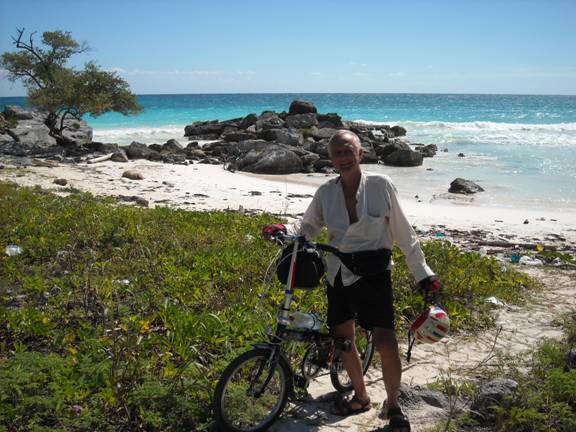
Caribbean waters of Riviera Maya south of the Tulum temple ruins.
Excerpt from the book; FINAL REPORT AND THE MAYA by Michel D. Coe, page 206.
“Yucatán was the greatest producer of salt in Mesoamerica. The beds extended along the coast from Campeche, along the lagoons on the north side of the peninsula, and over to Isla Mujeres on the east.
The great majority of goods traveled by sea since the roads were but poor trails and cargos heavy. The kind of commerce was cornered by the Chontal Maya, or Putun, such good seafarers that Thompson called them “the Phoenicians of Middle America.” Their route skirted the coast from the Aztec port of trade in Campeche, Xicallanco, around the peninsula and down to Nito near Lake Izabal, where their great canoes put into exchange goods with the island Maya…
It was this trade that linked Mexico and the Maya, for they had much to exchange- especially cacao and feathers of tropical birds for copper tools and ornaments- and it was probably the smooth business operators conducted by the Chontal that spared the Maya from the Aztec onslaught that had overwhelmed less cooperative peoples in Mesoamerica.”
   Tulum remained an active trading port when the Maya of northern Yucatán’s classic period collapsed due to an unprecedented two-hundred fifty year drought that commenced in the year 800 AD.
   The Chontal Maya continued their sea-going trade transporting salt from northern Yucatán to the still active Mayan centers of Lamanai, Tikal and Calakmul in the dense canopy jungle far to the south. They also carried on sea-going trade to as far away as Veracruz, Cuba, Florida and Central America.
Tulum offered a port of refuge on the Caribbean coast behind the second longest coral reef in the world. Entry to the protection behind that coral reef was ingeniously provided by a range marker that when lined up made a safe passage through the narrow break in the reef possible. The most astonishing thing of all was that these Maya even made their range marker useable by night by placing a fire behind a window that lined up perfectly with the safe passage through the break in the reef.
    This area was well developed with infrastructure that included a straight paved sacbe road to the Mayan temple town of Cobá and a straight manmade navigable canal nearly ten kilometers long to the temple town of Muyil which lies some twenty kilometers south of Tulum. The canal is fully functional to this day.
     In 1975 the Territory of Quintana Roo became a state, but was seldom visited, had nearly no paved roads and tourism was unheard of outside of the newly created resort town of Cancún. Besides being undeveloped it was a smugglers paradise for clandestine merchandise that strangely found its way into Mexico by night. 
    One boast of Tulum today is that they still do not have a jail.
    Though the Riviera Maya has been discovered now by world travelers there are still some extremely affordable options for visiting Tulum. 


   For less that $10.00 USD or $120.00 pesos a day, the Hostel Lobo Inn Tulum gives bed and breakfast with so much free stuff thrown in it seems impossible to believe. Free internet, TV, air conditioning, drinking water, open kitchen, security lockers, free bicycle use, swimming pool and an unbeatable location; Located across from the Tulum Ruins entrance and an ADO scheduled bus stop with quiet paved bike paths and trails along the Caribbean coast and into downtown shopping.    Camping and motor scooter rentals are also available.

Jane at Hostel Lobo Inn Tulum where bikers and back packers gather.

The patio and pool area where coconuts and travelers hang out.

   Here I am with the happy, helpful and friendly management team of Hostel Lobo who make Caribbean vacations affordable and fun. Julio center and Manual on right are setting the standard for inexpensive tropical vacations…perhaps the best deal in all of Mexico.
Hostel Lobo Inn Tulum

Carretera Federal Chetumal-Cancún
bedbikeandbreakfastulum@hotmail.com
Tel. 984-8712190 or cel. 984-1067933

   The best deal on a studio apartment available on a weekly and monthly basis in downtown Tulum is at Bin Wayak Apartments where amazingly everything works and all is maintained in pristine condition. New, modern studio apartments have kitchenettes and wireless internet included. Convenient shopping is a short walk away in a quiet and pleasant neighborhood.
Bin Wayak

Calle Jupiter between Sol y Murcurio streets next to the Lavanderia Burbujas
Centro Zona Maya, Tulum, Q. Roo tel. 984 7459966
www.binwayak.com

Fresh Caribbean air and quiet tranquility plus a super location for shopping, dining and the ADO bus terminal are an easy walk away.

Bicycle friendly with easy access to the beaches, shopping and a variety of interesting dining spots that have a laid-back Caribbean flavor featuring fresh sea food are reachable on quiet back streets and paved bike paths

Owner, developer and hospitality chief of Bin Wayak studio apartments, Tirso Monxón Ambrossi makes a wonderful place even better with his perpetually jovial disposition that invites your return.


You will not need air-conditioning here with huge screened opening windows that let in the trade-wind tropical fresh air.

Convenient bicycle parking and tranquil patios where year-round temperatures hover in a salubrious comfortable range that allows the warm trade-winds to make life easy and un-rushed are sure to beckon your return to Tulum.

Today transport and commerce connects the Riviera Maya and Tulum to the rest of the world by paved highway but the pristine Caribbean waters and fresh trade-wind breezes remain.
More Tulum information, visit our website: www.bicycleyucatan.com/tulum

 
www.mapatulum.net


©2010 John M. Grimsrud

Tuesday, November 2, 2010

FALL STORM AT THE SUPERIOR, WISCONSIN INLET November, 1968


FALL STORM AT THE SUPERIOR, WISCONSIN INLET November, 1968

The Superior, Wisconsin/Minnesota Point inlet and lighthouse pictured in calm weather;
Note; the following short story goes with this photo because of its geographical location.
It is a common occurrence to have at least one very violent storm in this season on Lake Superior but this one was exceptional.

Jane and I along with my father, who was living with us at the time, drove out late this Sunday afternoon onto a narrow finger of land known as Wisconsin Point.
We went to see just what the raging lake would be like whipped into a frenzy by almost one-hundred mile per hour winds.
While we parked our car the wind sent shudders of blasting sand mixed with icy pelting spray that coupled to make a deafening roar.
The sight was beyond our belief while we watched the sixty foot tall lighthouse tower on the east jetty completely buried in crashing seas.
There were four people trapped inside the lighthouse structure and several days would pass before they could leave their imprisonment.
The approach to that lighthouse had been constructed of huge boulders the size of small houses and those mammoth waves crashing into and over them actually scattered the rocks about like so many pebbles on the beach.
If this sounds bad you will not believe the sickening horror we felt as the next chain of events unfolded.
There we saw out on the lake and headed into port was an eight-hundred foot great lakes iron ore freighter with the full brunt of that savage storm sweeping it along on a path of no return. As large and as powerful as this ship was it was no match for the killer storm.
With the wind on their stern it would be utterly impossible for the crew to turn their ship into the wind and their fate was sealed. They had no other choice but to run the inlet.
What we witnessed next made our hearts nearly stop. We held our breaths and watched a super huge wave break under the stern lifting this mighty ship and sending it into a broach position which then turned it beam to the sea.
The power and force unleashed here took all control out of the hands of the crew. Their fate rested with Mother Nature while the ship washed out of control sideways.
In the blink of an eye it was over. The massive vessel had gone surfing sideways through the outer and inner jetties and then into the safety of the harbor.
For those aboard that got to stair the Grim Reaper squarely in the eye that blink of the eye must have felt like an eternity.
After witnessing this assume event Jane and I still went on and ventured out there onto Lake Superior to confront the mighty Gitchi Gami big sea waters. 
In 1972 Jane and I set sail away from Superior, Wisconsin aboard our home designed and built 46 foot sailing vessel Dursmirg. We crossed the Great Lakes, Erie Barge Canal and Hudson River to New York where we turned south to begin many years of ambitious adventures
We have written and published the four volume story of that escapade entitled, Travels of Dursmirg.