Friday, June 10, 2022

The Tyranny of Public Discourse: Abraham Lincoln's Six-Element Antidote for Meaningful and Persuasive Writing by David Hirsch - Book Review


Book Review - Five Stars 

The Tyranny of Public Discourse: Abraham Lincoln's Six-Element Antidote for Meaningful and Persuasive Writing by David Hirsch

This short intensely intellectually powerful tome evolved out of the great minds of Thomas Jefferson and Abraham Lincoln who wrote and edited America’s bedrock founding documents. I loved the book’s focused mindset that strictly applied the extraordinary rigid guidance essential to the presentation of these great communications.

EXCERPTS:

Jefferson and Abraham Lincoln light a road to the persuasive structure of the six elements of a proposition. Lincoln put the goal succinctly: “I do not seek applause, nor to amuse the people, I want to convince them.”2 Abraham Lincoln used the logical structure of a six-element proposition to draft the Gettysburg Address.3 Thomas Jefferson used the same structure to draft the American Declaration of Independence.4 The elements are 1) Enunciation (contains a given and a sought); 2) Exposition; 3) Specification; 4) Construction; 5) Proof; and 6) Conclusion. Each element is a structural concept with a one-sentence definition. Proclus preserved the six one-sentence definitions.

Thomas Jefferson was among America’s best educated individuals.8 Abraham Lincoln’s “defective” formal education was less than one year.

September 18, 1858, Lincoln responded to the Douglas personal attack on Trumbull: Why, sir, there is not a word in Trumbull’s speech that depends on Trumbull’s veracity at all. He has only arrayed the evidence [the Construction] and told you what follows as a matter of reasoning [the Proof]. There is not a statement in the whole speech that depends on Trumbull’s word. If you have ever studied geometry, you remember that by a course of reasoning Euclid proves that all the angles in a triangle are equal to two right angles. Euclid has shown you how to work it out. Now, if you undertake to disprove that proposition, and to show that it is erroneous, would you prove it to be false by calling Euclid a liar?


John Grimsrud's author's page

Tuesday, June 7, 2022

Natural Health, Natural Medicine: The Complete Guide to Wellness and Self-Care for Optimum Health by Andrew Weil, MD.


Book Review - Five Stars

Natural Health, Natural Medicine: The Complete Guide to Wellness and Self-Care for Optimum Health by Andrew Weil, MD: A compendium of healthful guidelines that treat your body and mind to natural solutions for a better life.

I loved the book’s direct to the point delivery, and useful and meaningful solutions.

The book is a great reference text.


EXCERPTS:

How much metal dissolves out of pipes and connecters depends on how corrosive the water is that flows through them, how hot it is, and how long it stays in contact with the plumbing. The corrosivity of water depends on its chemistry—how acid or alkaline it is and how many dissolved minerals are in it. The fewer minerals are in the water, the more it can take up, hence the more corrosive it is. Ironically, some kinds of purified water are more corrosive to metal piping than impure water just because they can hold more dissolved metals. This is an argument against attaching a purifier at the point where water enters the house; it’s better to put it at the end of the piping, near the tap.

In the twenty-first century our livers are sorely taxed. Not only do they have to deal with all the naturally occurring toxins, but they now have to face a staggering array of man-made compounds: medical and recreational drugs, food additives, pollutants and contaminants of air and water, and the dangerous chemicals people are exposed to on the job and in the home. The sum of all this chemical stress may, over the years, contribute to decreasing immune system defenses against cancer.

Minimize exposure to pesticides, herbicides, and other poisons. This is a highly dangerous group of chemicals.


Sunday, June 5, 2022

Dad's Story in the Doings of Dudley Doolittle


The time is right to put this story up. This month is my dad's birthday.  John A. Grimsud was born June 29, 1908. I miss him.

This is a story about Peoples Drug Store in the Roaring Twenties told to me by my dad when I was a child.

Dad was sixteen years old in 1924 while America was riding the speculative economical rollercoaster fueled by post WWI industrial expansion.

Prohibition had the country swilling clandestine bootleg booze in gangster controlled speakeasies

Hyperactive 138 pound Dad was self-motivated at an early age. He had three newspaper delivery routes at the same time employing a helper. He mopped floors and did janitor work mornings before school at Peoples Drug and repaired bicycles in his spare time.

Early one morning as dad was slipping his key into the door at Peoples Drug Store to begin his janitor job, a big long car screeched up to the curb, stopped and three machine-gun wielding men scrambled out.

Dad was pushed inside and forcefully ordered to open the safe at gunpoint. He nervously told the menacing gangsters his only duty was to mop the floors and carry out the trash 

These Al Capone type gangsters were in a big hurry and luckily only locked Dad in the basement coal room instead of blasting him to bits.

In the pitch-blackness of the coal room dad’s thoughts quickly turned to the idea of escape. He felt his way around in the blackness and found the coal shoot leading up to the small street-side door.

This would be his escape route. 

Dad then stealthily crept his way up the coal shoot and carefully pried open its little door. As he cautiously peered out he was terrified to be looking down the barrel of a machine gun. Dad thought that his heart would explode as he gingerly lowered the little door with a trembling hand.

The gangsters grabbed what they could quickly picking up items, breaking into the narcotics drawer, and then sped away with little more than a sack full of Parker fountain pens and lots of drugs.

Dad said that the incident didn’t bother him for about a week and then suddenly flashbacks would startle him out of a sound sleep with sweaty terrifying anxiety.

Dad went on to get his pharmacist license and eventually became the owner of the Peoples Drug Store by the early 1940’s buying it from O. B. Olson, the original owner.

Postscripts:

Those gangsters were apprehended a few weeks later and one of the things that helped convict them were all of those expensive Parker fountain pens.

Five cents: Nowadays five cents doesn’t seem like a lot of money but when I was a kid ten years old back in 1950 it would buy you a newspaper, five U. S. postcards, three second class postage stamps, soft drink, candy bar, ice cream cone, refillable cup of coffee or a bowl of rice at the Chinese restaurant. 

Peoples Drug Store had an ornate soda fountain/lunch counter featuring hamburgers that were greased to kill. My favorite soda fountain beverage at the lunch counter was the 5¢ Coca Cola that came in several flavors all made from extracts known as phosphates, the charged water was added. Cherry flavor with a dash of chocolate was sensational. 

I started working at Peoples Drug Store when I was fourteen cleaning shelves, washing bottles, washing windows, shoveling/sweeping the sidewalk, and burning garbage. 

At sixteen years old I started waiting on customers, stocking shelves, and doing the inventory. When I got my drivers license I did deliveries and got to know a lot of people in the five years I worked there.

The store had three full time pharmacists, Bob Cleary, Bud Dice, and my dad.At the time there were fourteen drug stores in Superior, and none were chain operated. 

There you have some of my Peoples Drug  recollections.

The 1950s: The 1950s opened with witch hunting McCarthyism and Eisenhower's team headed by Richard Nixon and Earl Butts that set out to undo all of Franklin Roosevelt's social justice programs. 

Community oriented mom and pop businesses along with family farming, labor unions, and Indigenous rights vanished. Murdered by capitalism.

John's author's page

Wednesday, May 4, 2022

Guckin: A True Story, is the fifth short story in the series Doings of Dudley Doolittle

 Guckin: A True Story, is the fifth short story in the series Doings of Dudley Doolittle

In this edition the character Dudley has the nickname of Guckin

It is true, my friend’s nick name was Guckin and he went on to do some great things in life even though he wasn’t good-looking or well built.

This story is about a time in his youth when he was working his way through college by instructing at a summer camp.

Now Guckin didn’t have a very easy time getting dates with the girls so when he connected with the town beauty he took great pride and pleasure in showing her off as he would drive her about town in his car.

Well it turns out that one night Guckin’s good looking roommate wanted to borrow Guckin’s car for a special date…Guckin just couldn’t refuse and turned over the keys.

Horror of horrors, it turned out that the roommate had taken not only Guckin’s car but he had also taken out Guckin’s girl…Guckin was crushed!

Not one to take these things lightly, Guckin knew he had to take action, and so the plan was hatched.

One thing that Guckin observed was that his roommate was not only good-looking but he was excessively vain and would spend hours primping and combing his wavy thick hair in front of the mirror.

Guckin had it, he was off to the pharmacy to purchase some hair removal cream which he mixed with his roommate's hair cream…the results were like magic and large clumps of his roommate's hair fell out.

The roommate asked Guckin what to do and Guckin told him that he probably wasn’t using enough hair cream.

It worked perfectly well and Guckin was back with his girl friend in no time. Well, the girl friend asked Guckin one day what had happened to the roommate and Guckin told her that he had contracted some unmentionable disease and his hair was falling out so he didn’t want to be seen in public.

The moral of the story is this: You shouldn’t be muckin with Guckin!

John's author's page on Amazon

The Viking Heart: How Scandinavians Conquered the World by Arthur Herman - Book Review - Five Stars

 Book Review - Five Stars

The Viking Heart: How Scandinavians Conquered the World by Arthur Herman

The author of The Viking Heart, Arthur Herman, wrote:

“Her journey showed off many of the qualities that made her distant ancestors, the Norsemen Vikings, famous: physical and moral courage, determination and adaptability, a deep loyalty to family, and a commitment to cultural heritage, which for her included the Lutheran Church.

The only persons more revered in my grandmother’s house than Franklin Roosevelt were Martin Luther and Leif Erikson, the Viking discoverer of America.”


This book covers more than a thousand years of evolutionary history from a time when nation states had no defined borders, political leadership was roused by local chieftains whose religious beliefs had evolved and dated back in time to antiquity.

Discover who these real people were and the impact they have had in the past thousand years.

I loved this well researched, precisely edited, and fun to read book that moved along with no dull moments.

EXCERPTS:

Winston Churchill would write: “When we reflect upon the brutal vices of these salt-water bandits, pirates as shameful as any whom the sea has borne, or recoil from their villainous destruction and other cruel deeds, we must also remember the discipline, the fortitude, the comradeship and martial virtues which made them at this period beyond all challenge the most formidable and daring race in the world.”


Minneapolis. By 1903, it was the second-largest Scandinavian city in the world, after Stockholm

“the land of the free” was also the land where self-reliance came with a warning label: caveat emptor, or “buyer beware.”

After winning full independence in 1905, Norway followed a similar economic upturn as its government pursued what can be accurately described as free-market policies. It also became the first European country to give women the vote (Denmark followed suit in 1915, while Sweden’s women had to wait until 1919).

John's author's page

Tuesday, April 19, 2022

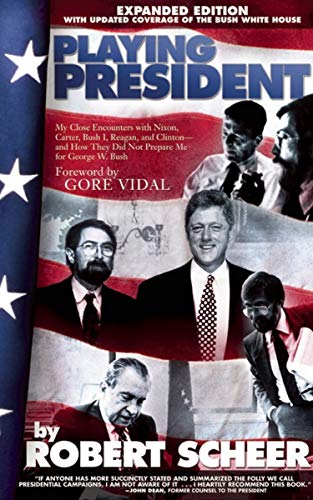
Playing President: My Close Encounters with Nixon, Carter, Bush I, Reagan, and Clinton—and How They Did Not Prepare Me for George W. Bush by Robert Scheer


BOOK REVIEW - FIVE STARS

Playing President: My Close Encounters with Nixon, Carter, Bush I, Reagan, and Clinton—and How They Did Not Prepare Me for George W. Bush by Robert Scheer

Well-written, greatly insightful, and very timely. This compendium of historical political leaders that shaped world history is a must read for all.

I loved it!

Excerpts:

Truman, guided by that brilliant lawyer Dean Acheson, was quite aware that by 1940 the world Depression of the early ’30s had returned. The New Deal of Franklin Roosevelt had largely failed. What was to be done? FDR took a crash course in Keynesian economics. As a result, he invested $8 billion into re-arming the United States, in order to hold our own against the Fascist axis of Germany, Japan, Italy. To the astonishment of Roosevelt’s conservative political enemies, the U.S. suddenly had full employment for the work force and a military machine of the first rank with which we were able to defeat Fascism, and just about anyone else who defied us. Truman and friends learned and never forgot an important lesson:

“Freedom of the press is guaranteed only to those who own one,” and in the time of Jefferson, that group included much of the electorate.


Nixon “did a number of undeniably good things that have been forgotten. He negotiated the first and only strategic arms limitation treaty, the opening to China. He ended the war, ended the draft; the eighteen-year-old vote came under his presidency. He did a lot of good things and they all got swept away by Watergate.”

Nixon’s foreign policy achievements are the focus of the current reappraisal, though some commentators also praise aspects of his domestic policy, especially his establishment of the Environmental Protection Agency and his efforts to reform the welfare system.


Ironically, when I had asked Carter during our 1976 Playboy interview what would prevent his leading the U.S. into a Vietnam-type quagmire, he stated that he wouldn’t “lie,” as Lyndon Johnson had. At the time, I thought this was the most truly controversial statement in the interview—not the “lust” quote that was so widely publicized. Johnson’s widow, Lady Bird, felt the same way, and she initially refused to meet with Carter when he landed in Dallas soon after the interview was published. Sadly, Carter went on to commit the same lie of inventing a national security threat—with dire consequences.


John's author's page on Amazon

Valiant Ambition (The American Revolution Series) by Nathaniel Philbrick


BOOK REVIEW - FIVE STARS

Valiant Ambition (The American Revolution Series) by Nathaniel Philbrick

An eye opening look at the rocky road United States stumbled through on its way to independence. I found this story extraordinary and enlightening, and far more revealing than all of my previous studies had taught me.

The provocative history was not a slam dunk described in history books. This is truly recommended reading.

Excerpts:

Like many American mariners and merchants, Arnold’s early revolutionary beliefs had been nurtured in the smuggling trade. For men like John Hancock in Boston and Arnold in New Haven, finding a way around the stifling economic restrictions imposed by the British government had been not only a financial necessity but an expression of patriotism, a finger in the eye of the British regime. Now that the Continental Congress in Philadelphia had proven to be, if anything, even more dysfunctional and unjust than the ministry in London, Arnold saw nothing disloyal in doing what Americans had always done: profit as best they could from whatever


The city was a shambles. The British had used the State House as a prison, and the floors of its once immaculate rooms were heaped with human waste. The newly returned delegates of the Continental Congress had to meet temporarily in nearby College Hall until the filth could be removed. Other public buildings and “genteel houses” had been used for stables by the British, who cut holes in the floors so that the dung could be shoveled into the cellars. According to the New Hampshire delegate Josiah Bartlett, “The country northward of the city for several miles is one common waste, the houses burnt, the fruit trees and others cut down and carried off, fences carried away, gardens, and orchards destroyed.” Over the course of the next few weeks, thousands of citizens who had spent the winter outside Philadelphia flooded back into the ravaged city. Not unexpectedly, they had little sympathy for anyone who had fraternized with the enemy.


The United States had been created through an act of disloyalty. No matter how eloquently the Declaration of Independence had attempted to justify the American rebellion, a residual guilt hovered over the circumstances of the country’s founding.

By threatening to destroy the newly created republic through, ironically, his own betrayal, Arnold gave this nation of traitors the greatest of gifts: a myth of creation. The American people had come to revere George Washington, but a hero alone was not sufficient to bring them together. Now they had the despised villain Benedict Arnold.

As Arnold had demonstrated, the real enemy was not Great Britain, but those Americans who sought to undercut their fellow citizens’ commitment to one another. Whether it was Joseph Reed’s willingness to promote his state’s interests at the expense of what was best for the country as a whole or Arnold’s decision to sell his loyalty to the highest bidder, the greatest danger to America’s future came from self-serving opportunism masquerading as patriotism.


John's author's page on Amazon

Friday, April 15, 2022

Captain George Tappin: A True Story.


Captain George Tappin: A True Story is the fourth short story in the series the Doings of Dudley Doolittle.

Though our old and trusted friend George Tappin is long gone he lives on fondly in our memories.

Therefore we will use his real name here and make this story a  tribute to Captain George.

Our first experiences with commercial fishing in Florida: I took George Tappin up on his offer of a day out on his shrimp trawler, Terry. It turned out that George’s wife Mary was scared to death to go out to sea with George because of an incident that occurred when they were coming in the inlet in very heavy seas. George had been going out by himself, which to me seems impossible, but he did do it just the same. The first trip I made with George was a wonderful experience, and I asked if he would mind taking Jane the next time and he agreed. The one thing that happened the first day I was out with George was that one after another his bilge pumps all failed. He rigged another and another until his seventh one didn’t work. He was a real resourceful sailor and instinctively went down to his main engine that was a 6-71 Detroit Diesel and rerouted the engine raw water pickup hose to suck the bilge water and discharge it overboard. That was enough to keep us afloat until we could get back to the dock. I have to state here one of the basic rules of boating; “the water is supposed to be on the outside.”

Jane’s reaction on her first trip out on the Terry with George was that she wished that she hadn’t wasted so many years working at the finance company back in Superior, Wisconsin. She could have been out here upon the ocean instead. There was always plenty of action on the shrimp boat.

One of my jobs on George’s boat was to open the net when it was hauled onboard and hoisted high up in the rigging. To visualize this you must consider that the boat is always in constant motion while it passes through the seas. When the full net is overhead, I would go under it and grab hold of the trip line that would open the bag portion of the net to release the catch. Timing and coordination are crucial because if the net isn’t opened at the precise time, the catch can be released back overboard while the roll of the boat keeps the net perpetually swinging overhead.

The varieties of living things that come out of the net are astounding. Crabs with their pinches poised to shake hands with you, catfish with their dorsal fins ready to stab, sting rays with their tails armed with a jagged venomous spear, electric skates will jolt you, sea turtles just want to snap, but sharks want a piece of flesh. One day when I opened the net, out came a 7-½ foot shark that was flipping around the deck like a bucking bronco but at the same time was vigorously snapping its razor sharp teeth at everything in sight. I instantly got the message and sprung up in the rigging and told George that he had a visitor to take care of. George didn’t bat an eye and came from the wheelhouse with a carpenter’s knife and took a flying tackle on the shark. Next, he slit the shark’s bottom side from one end to the other and spilled the shark’s guts onto the deck. Now the shark got even more aggressive and snatched our fishing net in its razor toothed mouth and began to aggressively thrash. Again I called George and told him of the new problem. This time he came with a hammer and commenced to bash in the shark’s head. Now the shark became docile for a moment and George then fastened a rope to the shark’s tail and hoisted it up into the air using the winch. With the roll of the boat, the shark swung overboard, and George then let the shark down so that he could cut the rope on its tail. The shark was back to thrashing again and when the rope was cut and it hit the water, the other sharks in the vicinity completely tore this shark to shreds in a seconds. After witnessing this chain of events I was convinced that you never wanted to fall overboard from a shrimp boat. For the remainder of this winter season, Jane and I went out fishing with George Tappin two or three times a week. This was some of the best fun we had our entire time in St. Augustine this winter season. We thought of ourselves extremely fortunate to be able to have this life changing opportunity. We even got paid plus as a fringe benefit we had all of the seafood we could eat.

More colorful stories of Captain George Tappin can be found in our books of our life aboard our sailboat Dursmirg. Check the following links.

Sailing Beyond Lake Superior : Travels of Dursmirg

Sailing to St. Augustine: Travels of Dursmirg

Remembering 1954: Marjories Kennen Rawlings and George Tappin

Dying of cancer the last words George spoke to me from his death bed were “John, I would give anything if I could just walk out that door.”

John's author's page on Amazon


Tuesday, April 12, 2022

The Baker Chocolate Company: A Sweet History by Anthony M. Sammarco


BOOK REVIEW - FIVE STARS

The Baker Chocolate Company: A Sweet History by Anthony M. Sammarco

Growing up with America, this popular brand was a standard product in homes across the nation. I loved the book’s historical impact with its beginning in precolonial Mexico thousands of years ago and then the popularity that has gone world wide.

The book takes the reader in to the age of corporate take overs and thus is timely.


EXCERPTS:

The exact significance and attributes of Quetzalcoatl varied somewhat between each of these civilizations and throughout history. Quetzalcoatl was often considered the god of the morning star, while his twin brother, Xolotl, was considered the evening star. As the morning star, Quetzalcoatl was known under the title Tlahuizcalpantecuhtli, which means literally “the lord of the star of the dawn.” He was known and worshiped as the inventor of books and the lunar calendar, the giver of maize corn to mankind and sometimes as a symbol of death and resurrection. Quetzalcoatl was also the patron of the priests and held the revered title of the Aztec high priest.


Baron Justus von Liebig (1803–1873), noted German chemist who made significant contributions to the analysis of organic compounds and the application of chemistry to biology and agriculture, was quoted in the 1893 edition of Baker Chocolate’s Choice Recipes, stating that chocolate is a perfect food, as wholesome as delicious, a beneficent restorer of exhausted power; but its quality must be good, and it must be carefully prepared. It is highly nourishing and easily digested, and is fitted to repair wasted strength, preserve health, and prolong life. It agrees with dry temperaments and convalescents; with mothers who nurse their children; with those whose occupations oblige them to undergo severe mental strains; with public speakers, and with all those who give to work a portion of the time needed for sleep. It soothes both stomach and brain, and for this reason, as well as for others, it is the best friend of those engaged in literary pursuits.

John's author's page on Amazon

Monday, April 11, 2022

A History Lover's Guide to New York City (History & Guide) by Alison Fortier

BOOK REVIEW - FIVE STARS

A History Lover's Guide to New York City (History & Guide) by Alison Fortier

Fun to read, educational and extremely interesting. I loved the well-edited and organized presentation that left me with many happy recollections.

EXCERPTS:

A popular referendum on creating a Greater New York passed in 1894. It took a few more years to realize what this would mean in practical terms. On January 1, 1898, Manhattan, Brooklyn, Queens, the Bronx and Staten Island became the five boroughs, or administrative units, of one New York City. By a "stroke of a pen," New York's population increased to three million, making it the second-largest city in the world after London.


The last sixty-five years have been mostly good ones for New York City. The exception was a period during the 1970s when the city’s finances failed. Government overspending and the departure of industry and jobs to cheaper areas hurt New York as a place to live and work.

High unemployment and escalating crime, rampant drug use and inadequate public services left garbage piling up on street corners and graffiti on buildings and subway cars. New York City was a difficult place to live. Population numbers declined—not until the 2000 census did the population exceed what it had been in 1950. A citywide power blackout in 1977 symbolized the city’s fate. The future looked dark. At its depths, New York City appealed to the federal government for financial aid to avoid bankruptcy. The administration of President Gerald Ford denied the aid. The New York Daily News paraphrased the president’s position in its famous October 30, 1975 headline: “Ford to City: Drop Dead.” Despite the fact that the Ford administration reversed itself within a few months and offered federal loan guarantees to New York City, Ford narrowly lost the state of New York to Democratic nominee Jimmy Carter in the 1976 presidential election. Jimmy Carter went on to the White House to become our thirty-ninth president. Gerald Ford blamed this headline for costing him the election.


John's author's page on Amazon