Showing posts with label Jane Grimsrud. Show all posts

Thursday, January 11, 2024

Our Year - 2023


Our Year - 2023

First the fun things:

Alix and Basil paid us a visit in January and released us from our pandemic exile. They tested negative for Covid before we met for our first breakfast out since March of 2020. We had a wonderful time with them.


Jane’s cousin Lyle and his wife Diane took a cruise ship from Galveston, Texas, to the Port of Progreso. We took a Didi taxi to Progreso and met them for several hours of talking and eating. Jane felt honored by the visit.


In May we spent a month in Playa del Carmen visiting with Grisel and her husband Juan...always fun. Grisel has a big place in our hearts. We wish she lived closer to us.


Breakfast out is our favorite activity. We had many with Rosario May and her kids. We celebrated all our birthdays at a breakfast.


For the Record:

In 2023 a striking difference from other years was climate change, record heat, an increase in pollution, and flaming red sunsets at our home in tropical Mérida, Yucatan Mexico, 21º North Latitude. Mérida is city of nearly two million with far too may motor vehicles plus mega power plants straining at their limits.

Twenty-seven percent of Yucatan’s agricultural land has been lost to ever expanding growth.

Fifty years ago when we first arrived in Yucatan, Mérida's population was 175,000 with three gasoline stations, and bicycling was a lark. We had blue sky above and thousands of bright stars at night. Wellwater was safe to drink. Half the housing in Yucatan was made of 100% recyclable materials sourced from the forests. These palm frond thatched homes have vanished replaced by Tio-Sam cement block houses not environmentally friendly making brown outs irritating. The finite potable water supply is dangerously low. Droughts have devastating impacts making wild fires deadly and dangerous. There are just too many toilets to flush! Even with these problems the city is expanding at a roaring rate with no end in sight.

I had read the books by John L. Stephan's of his Yucatan exploration of 1842. In the appendix of volume 1, pages 264 to 271, the morning, noon, and evening temperatures were recorded in an airy shaded place for a year and a half. Those temperatures never exceeded 89ºF. Temperatures we encountered in 1980s Mérida were the same as 1842.


During the last five years climate change significantly accelerated. We had eight consecutive months of record setting temperatures above 100º F or 38ºC every day. Mérida went from a scorching oven to a blazing hell: A preview of coming attractions.

Note: listen to the audio book; Fire Weather: A True Story from a Hotter World by John Valliant to see where our environment is headed.

To avoid the hot season last May, we went to the Caribbean Coast for a month.

On our return to Mérida we coped with the heat in our ecologically friendly home. With no air conditioning unit we used nature to our advantage.


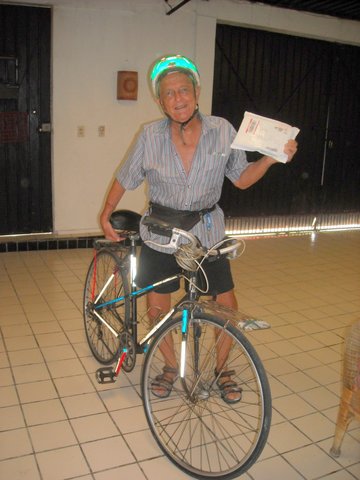
We continue to do our daily exercise routine that includes bicycling and eating breakfast out weekly. Getting around town and to the beach have become wonderful and affordable using the Didi taxi service. There is no excuse for owning a car in Mérida.

Guarding our health is still extremely imperative. The pandemic plus yearly influenza coupled with mosquito-born infections make peremptory precautions of inoculations, social distancing, and face masks essential for senior citizens, and those with asthma absolute necessity.

For amusement Jane has been giving me bread making lessons...she ingeniously has been baking bread from age 10 with the priceless lessons from her two Swedish grandmothers and her mom...I am not yet at graduate stage of learning the thousands of culinary tricks. The learning curve seems unending...it is fun, creative and educational.

We never run out of fun and interesting things to learn and do. We read a lot of books and also listen to audio books. John reviews the books he reads on his blog.

Wishing for an adventurous and healthy 2024.

View my author's page on Amazon

Sunday, February 12, 2023

Canoeing the Brule River in Winter - Stories February 2023


This is a 2023 reprint of Canoeing the Brule in Winter that contains numerous updates plus some facts that richly enhance this curious adventure story.

First, the geographical location: Lake Superior is 604 feet above sea level nearly centered in North America. It is largest of the five fresh water Great Lakes with a depth of more than 1300 feet. Its depth reaches to 700 feet below sea level.

It is truly a significant body of water and noticeably affects the surrounding weather.

I still remember the weatherman commenting at the end of his weather forecasts “cooler near the lake.”

Near Lake Superior it was so much cooler that we jokingly said “We hope that summer would come on Sunday.”

The following 2013 story by John M. Grimsrud has been updated to reflect the latest subject matter.

“A boat trip down the Brule is an experience never to be forgotten. One may start at Stone’s Landing, first going upstream a short distance to see the Blue Spring, then down through Rainbow Bend, Cedar Island, Wild Cat Rapids, Ashland Lake, Winneboujou, Bayfield Bridge, Club House Falls and dozens of other scenic spots. One gets a thrill out of shooting the rapids and dreams of the sturdy voyagers who traveled this route back in the seventeenth century.”

Leigh P Jerrard, The Brule River of Wisconsin, 1956.

The Brule River is an extraordinarily pristine spring-fed river in northwestern Wisconsin. It empties into Lake Superior.

The Brule River has been used as a transportation link dating back into antiquity. First by the ancient mound builders, and then by countless indigenous tribes that followed.

The first verifiable commercial use of the Brule River: Amazingly the Indigenous left a distinct confirmable trail from the rich copper deposits of Upper Michigan, then up the Brule River that connects Lake Superior via a portage at the continental divide to Upper Lake St. Croix, the St. Croix River that then flows southward to the Mississippi River to the Gulf of Mexico. There they found an eager buyer for the copper. The Chontal Maya of Mexico had built an extensive trading network selling sea salt from Yucatan across the Gulf of Mexico, the Caribbean Sea, and from South America to North America.

These Chontal Maya, descendants of the Olmec who had numerous discoveries that included Indian corn and the ingenious processing procedure known as nixtamalization that made corn digestible for humans, chocolate, potatoes, squash, and beans along with a multitude of drugs in use to this day.

That distinctive copper from Upper Michigan has been identified in museums of ancient artifacts.

Now to present times and the Brule River:

Daniel Greysolon Du Lhut was the first white man to ascend the Brule and leave a record of his passage. He was soon followed by others: fur traders, missionaries in quest for Indian souls, pioneers, sportsmen, immigrants and adventurers.

Until the lumbermen came, beginning in the 1850s, to clear cut the virgin pine forests not leaving a tree for a bird to sit in, the land, forests, rivers and ecology remained pristine. Beaver and buffalo were happy, healthy and abundant.

One thing that helped save the Brule was the fact the Brule River valley was deemed to difficult to log. Luckily a man named Pierce bought it, built a fish hatchery, small lumber mill and lodge, leaving the rest in wilderness. When he passed on, the Ordway family continued the ecological conservation to this day forestalling the destruction of this unique ecosystem.

President FDR with his Civilian conservation Corp (CCC) put in stacked stone wing dams to maintain sufficient water depth for canoeing the Brule even in drought years. The area water table had declined as northern Wisconsin was denuded of its virgin pine forests.

I have canoed on the Brule every month of the year except December.

Years ago before the sound of screaming snowmobiles and roaring chain saws slaughtered the silent winter sanctity, I found one of the most enchantingly beautiful things to do was to slip a canoe off the untouched snow covered river bank into the pure unspoiled water of the Brule at a place called Stone’s Bridge Landing.

The river is fed by icy cold spring waters originating up in high sand country. These continually flowing springs are what make it possible to canoe in northern Wisconsin in the winter. It is part of the southern continental divide of Lake Superior, and it is the only open river water in the area in the winter season.

One clear bright sunny March day back in the mid 1950’s when the noontime temperature inched into the thirties and springtime felt tangible, an adventure was launched.

My five young and somewhat reckless companions on the escapade were Don Frye, his two cousins Bud and Jerry Bunt, Dave Smith, and Dave Olson.

On that day that felt like spring, we slipped three canoes into the icy river waters at Stone’s Bridge Landing for the 23 mile down river trip to the town of Brule. It was sunny and bright in this land of sky blue waters, and the sun felt like a long lost friend that had come back to visit after a brutal northern Wisconsin winter.

In the shade along the banks the drooping cedar trees that stand tall and sprawling next to the sparkling clear river waters cast their shadows down on places where the water runs slow. There a sheet of ice speckled with sparkling snowflakes could still be found.

We departed silently into a quiet world and glided along this enchanted waterway.

As we effortlessly drifted downstream, the thin ice crackled as it fractured and broke from the wake of the canoes. The winter silence was so enchantingly striking it made us all want to whisper.

In this polar deep-freeze, even with the friendly sun beating down upon us, we noticed our canoe paddles thickening with each stroke. They caked with layered ice similar to a candle being dipped in wax.

The first sixteen miles of river is relatively calm with easy going waters.

Lofty balsams, stately cedars, and towering pines blanketed in deep drifted snow where whitetail deer alerted by our presence stood statue still made this wilderness magical.

The river pace picks up with a few rapids that shoot through rocky twisting narrows in the last seven miles of the sixteen mile long upper portion of the river between Stone’s Bridge Landing and the Winneboujou Bridge at Highway B. This part takes about five leisurely hours to traverse.

In the last seven miles between the Winneboujou Bridge and the town of Brule at Highway 2, the pace picks up perceptibly. Navigation of the rapids requires undivided attention and decisive split-second canoe handling abilities. This portion of the river can easily be made in less than an hour due to the spirited speed of the current as it tumbles through a rock strewn twisted corridor picking up momentum on its way down to Lake Superior.

At this time of year in these northern latitudes the sun is on the horizon and headed down about four-thirty in the afternoon.

It was late in the day, and we were racing to the end of our trip. I was in the lead canoe with Dave Olson when we entered a particularly treacherous stretch of river, the Long Nebagamon Rapids.

These rapids cascade continuously for almost a mile and at one point in the torrents the river makes an abrupt ninety-degree turn to the left with a straight up and down wall on both sides. The canoe must be turned well in advance of the corner or a disastrous collision with the wall will be inevitable.

This time the situation was made even more treacherous by the fact that over the course of the winter the river had frozen. Then next the water level dropped and left a shelf of ice protruding out from the wall a foot and a half above the water level. A canoe could easily slip under.

The first two canoes just made it. In the last canoe Don Frye and Bud Bunt rounded the corner. Bud, seated in the bow, reached out to fend off a collision with the ice shelf, but the powerful force of the water carried them under, and they capsized.

There was no escape from this raging cauldron of icy river water in those churning rapids until a half-mile downstream. At the bottom of these rapids, a calm-water pond converged with Nebagamon Creek.

As soon as Don and Bud could escape the river, they did. Scurrying up and over the huge snow drifted bank they began their life or death run through the twilight woods…if they stopped or had attempted the other river bank they surely would have frozen to death.

While they frantically ran with all the youthful strength that they could muster through the snow-covered heavily wooded forest, their clothing was rapidly freezing stiffer and stiffer with every labored step they took. Freezing to death was almost certain under these circumstances.

Their time was not meant to come this day. Amazingly, the path they ran led them to a small cabin with lights in the windows. They were mercifully taken in to thaw and given warm dry clothing by strangers…two young girls that were home alone.

Carl Pearson and his family lived in the cabin. When Carl returned home, he found all six of us huddled by the fire and pondering what to do next. With Carl’s help we rounded up our cars and canoes.

Little did I know at that time, but one of those merciful girls turned out to be a cousin to the woman that I married some years later.

My wife Jane’s uncle, Carl Pearson, was at the time the caretaker for Swiftwater Farm, Elizabeth Congdon’s place on the Brule River. Carl Pearson was a guide on the Brule River. He knew the river well. He marveled that we had all survived our folly.

 Swiftwater Farm on the famous Brule River in September 2008, the place where the winter canoe adventure ended.


John La Rock and Carl Pearson, c. 1950s. John La Rock (1897-1960) was a Metis Brule River fishing guide. He guided President Calvin Coolidge when President Coolidge summered at Cedar Island Lodge on the Brule River in 1928. John La Rock was the son-in-law of Antoine Dennis (1852-1945), another well-know Metis river fishing guide.


John La Rock and President Calvin Coolidge on the Brule River, 1928. Wisconsin Historical Society photo.


 My wife Jane is pictured in 2008 with part of the famous somewhat reckless canoe team years later at the Sundown Restaurant in Maple, Wisconsin. Crew members and lifelong friends; John (Bing) Grimsrud, Dave Smith, and Dave Olson.  


 My wife Jane Pearson Grimsrud, is a published author with three Brule area books to her credit. Her family roots are tied to the Brule River dating to her pioneering grandparents who relied on the river’s water when they first settled near the Brule in Cloverland, Wisconsin.

The Brule River has been a large part of Jane’s life from childhood.

The following books are available in paperback and digital editions worldwide: Lookingfor a New Frontier, the Story of the Edwin Pearson Family, 2010, and Brule River Forest and Lake Superior: Cloverland Anecdotes, 2013.

My author's page on Amazon


Tuesday, December 20, 2022

December 20, 2022: Our 53rd Wedding Anniversary


December 20, 2022: Our 53rd wedding anniversary.

I married my very best friend. She makes me happy and is so much fun with her extraordinary Swedish cynical humor.

Our third anniversary in 1972 was celebrated in St. Augustine, Florida, aboard our dream boat Dursmirg. That anniversary we also celebrated the completion of its maiden voyage and consummation of our five year building and escape plans. To complete our plan we had worked nights and weekends while going to night school three times a week and employed full time. A very aggressive time table left very little time for extra curricular activities.

We were asked if we had any regrets and I answered; “That we didn’t leave sooner.” Our friends claimed that we were workaholics and would never be able so slow down.

We proved them wrong in six months of dedicated effort.

We were also asked how we got so nice a big boat, and my stock answer was we got it for free.

So how did you get it for free?}

I said: “We didn’t watch TV for five years”.

Our new life was greater than our wildest expectations.

Now we are also celebrating our 50th anniversary of that five year plan that marked a monumental and positive turning point in our lives.

This is not the shortest day of the year but the longest night and marks the first day of winter.

Now the good news. Going forward the days will begin to get longer.

Where we now live in tropical Yucatán twilight passes faster than the blink of the eye and there is no snow here at 21 degrees north latitude.

I didn’t start living until I met Jane. She makes me so happy and is so much fun to be with.

I am such a lucky man to have such a loving and trusted wife.

I love my Jane just as she is, 100% natural spiced with cynical humor and with her magical attribute I adore...creativity.

Jane, you still make me happier than anybody in the whole wide world.

You are my sunshine, my only sunshine, you make happy when skies are gray.

Your ever loving Bing


Thursday, February 25, 2021

2021: John M. (Bing ) Grimsrud a brief personal profile


I live with my wife of 51 years, Jane, in our ecologically friendly home of our own design in Mérida, Yucatan, Mexico. Being minimalists and choosing to live with nature we have no motor vehicles, exclusively using bicycles, no insecticides or commercial food additives. Our home with its jungle garden is all natural with indigenous vegetation. The compost environment provides us with fresh 100% natural tropical eats year round.

We have three Mexican children, Guero Alex 46, Lupita 43, and Grisel 37. They have given us 6 entertaining spirited grandchildren ranging in age from 21 years to 2.

Jane and I have led an adventuresome and rewarding life of diverse traveling and educationally rewarding experiences by bicycle, canoe, sailboat, shrimp boat, camper van, cruise ship, freighter, train and airplane. We have lived in Wisconsin, South Carolina, Florida, Texas, and Yucatan, Mexico. Touring across, Canada, the United States, Mexico, the Caribbean Islands, and extensively across Europe from Norway and Sweden to Spain and Portugal plus from England and Ireland to the former East Block countries with annual tours averaging from three and five months.

Our various adventures and travels required expanding our knowledge base. Here is a brief list of some of those cognitive enhancement of learning we acquired: business management, architectural design, structural design, electrical/electronics both commercial and industrial, metallurgical properties, machine tool operations, cutting, welding and brazing, seamanship, boat handling, three semesters of sailing, coastal navigation, celestial navigation, atmospheric phenomenons, basic survival at sea, cabinet making, carving and joinery, diesel engine operations, seafood procurement and preservation, heating and cooling/residential and commercial, ceramic tile/carpet instillation, philosophy/personality profiling, history studies/American, Mexican, European, Viking and family. Our quest for knowledge is ongoing.

Still keeping physically active at 80 years of age and Jane at 76. we continue to bicycle every day. Ten years ago were were still averaging 40 to 60 miles of biking daily and gray hair was just beginning.

We are very happy to be quarantined together in our tropical sanctuary home with never a dull moment.


Books and blogs generated by our travels and studies:

Books available on Amazon.com, both digital and paper

Dursmirg travel series:

Sailing Beyond Lake Superior

Sailing the Sea Islands

Sailing the Florida Keys

Sailing to St. Augustine

Yucatan travel series:

Yucatan’s Magic

Yucatan for Travelers

Jane’s historical books:

Looking for a New Frontier, by Jane Pearson Grimsrud

Brule River Forest and Lake Superior, by Jane Pearson Grimsrud.

Our blogs:

Bingsbuzz

Note about our reading: Jane and I are avid readers averaging more than a book a week plus listening to audio books every night in our hammocks. I publish book reviews of books that I deem worthy of a five star rating and post them on my bingsbuzz blog.

Yucatan by Bicycle

Bicycle Yucatán – Yucatán’s Magic


Friday, December 13, 2019

We had a Dream - Half a century of Honeymoon


December 20th, 1969, our wedding day.

By the way: We didn’t get married on the shortest day of the year but the longest night.

We had a dream:
We were going where the wind blows, when the spirit moved us, and the price was right!
A half century later on December 20th 2019 our ongoing honeymoon continues.
Here is a synopsis from our book Sailing Beyond Lake Superior: Travels of Dursmirg.
When my father died in 1969, I thought about life and where it was going, realizing the most important person was Jane. I would marry her. When I asked she responded, “I suppose so.” I said, “You suppose so?”
On Jane’s lunch hour we drove to Carlton, Minnesota, a 17-mile trip in minutes. We filled out papers, paid a $5.00 fee and waited five days. They gave us two big bags of groceries. We had been together five years and found this humorous. Within an hour I had Jane back at her job.
Our secret was safe. Little did we know!
The rest of the story: The reporter from the Pine Knot, a weekly paper in Cloquet, Minnesota, gathered marriage information just after we received our license and went to press that afternoon. Jane’s friend picked up the paper and phoned her parents eighty miles away in Cloverland, Wisconsin.
The plot thickens!
A couple of hours later Judy’s parents got together with Jane’s parents for dinner.
The beans were spilled!
Five days later, we were back to Carlton and Judge Nordstrom’s house. He was a sprightly 85 year old and surprised us with an offer. He had to send our marriage document to the state, he could give us a copy with any date to show the family and friends. We amusingly declined.
My Jane was so very pretty. Excitedly she couldn’t decide which hand to put the ring on.
We had no plans for the day and drove to Duluth. Lunch was at a nice restaurant on the hilltop. It was an extraordinary day. Being together with my wife having lunch and looking over expansive Lake Superior, a frozen, snow covered vista that extended out beyond the eastern horizon. This was the route we would take on our soon to be completed 46 foot yacht.
My father had just died so we decided it best to have a get-together with friends and celebrate our wedding quietly. That evening we had a house full, and Jane cooked dinner.
Incredibly as long as we were keeping our secret, the family was keeping it too.
Time passed and Jane and I were sure we had kept our secret to ourselves.
We planned a nine-day honeymoon trip to Mexico City and Acapulco over Easter Week. I won the all expense paid five-star trip from a company I was doing business with. Our reasoning for Mexico was we would never revisit. Amazingly our home has became Yucatan in Mexico.
Before leaving on our trip, we thought it advisable to inform Jane’s parents of our marriage.
After dinner at Jane’s parent’s home, I told the group I had something important. Jane’s father said, “No, I have something to tell.” He couldn’t help chuckling while telling his story.
A happy man is a man who marries the girl he loves.
An even happier man is the man who loves the woman he married!
The half century of years from 1969 to 2019 have been an ongoing adventure for our tour group of two that generated four sailing books, two Yucatan travel books, several blogs, and a web site.

As I was lamenting the rapidly passing years, Jane said to me, “Be happy for what you have got.” and I replied “Yes, and what I have had.”


Friday, July 5, 2013

U.S. Postal Service?


Jane and I were given a very nice and thoughtful gift.
Jane’s sister Judy and husband Dick, out of the goodness of their hearts, sent us a book, The Brule River of Wisconsin.
The Brule River is of special interest to us. We have canoed it extensively, even in winter when we had to push our canoe through snow to reach the river, and we have enjoyed fishing for its trout and camping along its banks. Jane published a book in 1961 covering the pioneering, commercial fishing, and lumbering on the Brule.
Jane was also instrumental in bringing Leigh P. Jerrard, publisher of a 1956 book about the Brule together with Jane’s father, Ed Pearson, a noted historian and civic leader together. They, “Leigh and Ed” became friends, shared their historical interests and did explorations along the Brule River.
Leigh presented Ed with a copy of his Brule River book.  The book sent to us by Judy and Dick is a republication of Leigh P. Jerrard’s book with more maps and with additional stories by his grandson Richard Jerrard.
Here is the rest of the story:
July 21, 2013, the book was sent from St. Paul, Minnesota, registered with a tracking number. It weighed 13 ounces and the postage was $28.00. The book was three days in St. Paul and then was sent to New York, where it remained five days before going to Los Angeles, California…another five days detainment.
It arrived in Mexico City on July 2, 2013, cleared customs and was shipped to Mérida, Yucatan on July 2. It arrived on July 4. 

I picked it up at our post office on July 5.
Two weeks first class international registered mail.
I used to joke that if Mexico went to war I would bet on the opposition winning.
After this episode I have had to reconsider: Mexico delivered in two days, the
U. S. took two weeks.
Thus the question mark after service in the title of this story.